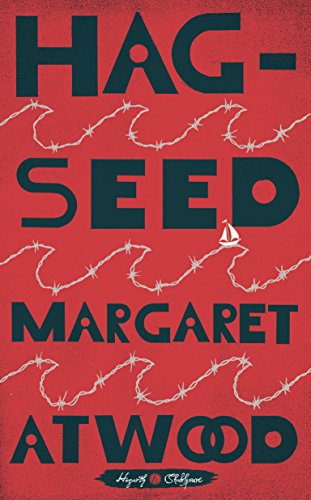
In this clever twist on of Shakespeare’s “The Tempest,” Margaret Atwood maintains her straightforward but perceptive narration style while telling the story of Felix, a run-down and hermit-like thespian who, much like Prospero, had his of social status and place in the theater ripped out from under him by his theater colleague, the Antonio-esque Tony, twelve years prior. Confined in his own sort of a prison yet purposefully hidden from his past, he’s seeking redemption under the guise of a unique staging of “The Tempest” with the Fletcher Correctional Players – a theater class/group he’s been teaching/directing with prison inmates. Little do his foes know, he’s been plotting revenge and they’ll be walking right into his carefully laid trap.
As thought-provoking on its themes of revenge, mercy, exploitation, and the good vs. bad in humanity as the play it’s based on, this novel would work for a number of audiences.
On the one hand, it’s a great retelling of a classic story, since it follows the same basic plot and features a corresponding cast of characters (pun intended). In this way, it makes a great introduction to “The Tempest” for those who might be hesitant to delve into Shakespeare (or have tried and thus far failed). “Hag-Seed” also stands on its own, however, despite the inspiration behind it and its obvious self-awareness to that inspiration (Felix is, after all, putting on a production of “The Tempest” and spends a lot of time talking about the play).
On the other, the many references to the play (and Shakespeare’s other works) and the theater-related subject matter would equally enthuse fans of the Bard.
As a reader who’s enjoyed Atwood’s writing before and simply wanted to a read a new novel, someone who only vaguely remembered “The Tempest,” and, simultaneously, someone on a recent Shakespeare sort of binge, I experienced this book somewhere in the middle and enjoyed it for all of these reasons. I found a good book to read, and, now, I also want to look further into “The Tempest.” So, win-win.
It also works as a companion to the play, making critical analyses and relating the otherwise seemingly estranged qualities of Prospero, Miranda, Ariel, Caliban, and company’s story to our modern contexts. “Hag-Seed” can make the original story for which it’s based feel all the more vivid, all the more real, and all the more digestible. The only thing that one might find lacking is Caliban and the commentary on slavery and colonialism that his character provokes. It could be hesitantly argued that, in other ways, Prospero and Caliban mirror each other, so perhaps Felix is meant to be both Prospero and Caliban, to some extent, here. That aside, such themes specific to Caliban were absent in “Hag-seed,” although it might have felt forced if present.
In the same way a contemporary-style theatrical production or film adaptation might, Atwood stages a rendition of “The Tempest” in literary form, making Shakespeare’s story come to life as she envisioned it. Shakespeare’s the playwright. Atwood’s the director (and more, of course). We’re the audience.
All in all, the writing and character presentation was rich in personality and evocative of real people and real life. Coupled with the already epic tale of “The Tempest,” “Hag-Seed” makes for a highly enjoyable and thought-provoking read. It was absorbing and compelling, and I entirely recommend it.