I don’t know how to win any other way but theirs. It is no recipe for a being a hero, but it is a recipe for success. I know how to drive a knife through my own hand. I know how to hate and be hated. And I know how to win the day, provided I am willing to sacrifice everything good in me for it.
Holly Black, The Queen of Nothing (book #3 in the Folk of Air series)
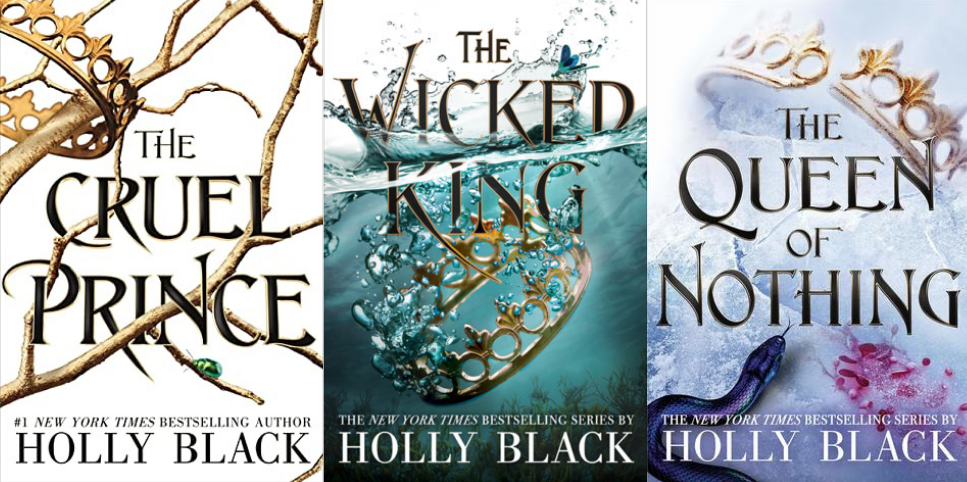
In the Folk of Air fiction series (made up of mainly The Cruel Prince, The Wicked King, and The Queen of Nothing), Holly Black paints a vivid, engrossing, and detailed world of faerie, one that will both terrify and enchant. If I were to say only one thing about these books, it’s that I devoured them – Then, much like the poisonously addictive “faerie fruit” that these books speak of, I quickly and hungrily wanted more and, in the short time between getting started on a book and then finishing it (only to wait impatiently for my library hold of the next-in-line), was frustratingly dissatisfied by anything that wasn’t. Yup, this sums up my feelings entirely and I could leave it there. Instead, take it as a fair-warning that this will be a totally glowing review, because I’m not, in fact, going to say just the one thing…
The Cruel Prince, The Wicked King, and The Queen of Nothing follow the adventures of Jude Duarte, a human girl primarily raised in the land and on the customs of faerie folk after her parents are murdered and she and her two sisters (human twin Taryn and faerie half-sister Vivienne) were stolen from their mortal lives as children, both abducted and adopted by the very faerie that killed their human family. After ten years, Jude is still trying to find her place within a world that hates her and come to terms with her conflicted sense of family and self. When the crowning of a new monarch dominoes into sordid happenings of intrigue and opportunity within her faerie home, she becomes caught up in politics of the treacherous, mysterious, and dangerous faerie kingdom like never before. Throughout the series, her roles and circumstances rapidly shift. Her determination to prove herself, curiosity to unravel hers and others’ pasts, and thirst to obtain control over and freedom from those who oppress her, however, do not. She is thrust into positions of deception, violence, and – what she craves the most – power, as she begins working alongside her childhood tormentor, the faerie prince Cardan, unable to predict the next turn of events nor trust anyone other than herself – and even there, unpleasant findings lurk.
Black’s world of fae is of a Tolkien-esque or C.S. Lewis type caliber but it’s also something exceptionally original. For fantasy-lovers (particularly those in love with the classics of fantastical storytelling, like the aforementioned), The Folk of Air series won’t disappoint. As such, Black’s faeries aren’t the benevolent, tiny-children-with-wings sort, but rather something much closer to (although further developed and wholly scarier) creatures like Titania and Oberon that William Shakespeare gave glimpses of in A Midsummer Night’s Dream. It’s a realm of cruel trickery and deadly charms, of corrupt rulers and scheming courts, and of outrageous reveling and intoxicating glamour. Equally, the characters are deceptive, dynamic, and deliciously colorful. Black has a true knack for confusing reader’s resolve and tricking the heart; The titular “cruel prince,” Cardan, provides his own roller-coaster sort of allure and repulsion, empathy and distrust for the narrator. Jude (who has grown up influenced by an alien sort of faerie morality) spends the series blurring the lines between good and bad and trying to figure out how far she’s willing to go to get what she wants – even when that means acting just like or sometimes worse than those she has been hurt by. Like all great fantasy, this series captures raw humanity with Black’s character dynamics and relationships despite dealing with a world of non-humans; She succinctly spins reality into her fantastical fables and legends, creating characters that live and breath and err and grow in a wonderfully flawed way and rendering her own sort of contemporary mythology while she’s at it. As Cardan phrases it in the short companion book, How The King of Elfhame Learned to Hate Stories (one to read after reading the Folk of Air trilogy and not before), “…stories tell a truth, if not precisely the truth.”
The contextually exciting blend of the fantastical of faerie life (widely predominant in the books) and the mundane of contemporary human life (with quick mentions of Target and peanut butter) makes for a fun take on the classic fairytale. Black adeptly includes and pays tribute to notions and rumors from old mythology and legends of fae, while flawlessly adding in her own to create a vibrantly complete universe. Through the seamless inclusion of bygone terms and phrasing mixed with other contemporary tidbits and norms, as well as its fierce and complex narrator, it is familiar enough to our historical and cultural reality to be evocative, clever enough to draw on the pre-existing, and imaginative enough to be completely riveting.
Like any good fantasy book, Black’s novels are magical and mystical and all-encompassing. But, they stand apart in the fast-paced and fresh story arcs and the narration of a character fully living in a timeless – albeit vaguely medieval – faerie world who also still has access to and is slightly familiar with the modern, mortal one. It’s not an entirely new concept but Black definitely adds her own twist to it. For example, there’s a wonderful juxtaposition that occurs with Jude’s character identity and traits: As a human with some “normal” human memories and experiences, yet also as someone who has been mainly raised in and whose life takes place in the world of fae, she doesn’t quite fit into either realm. It’s an interesting immersion into fairyland that such fantasy stories don’t usually tell in such a way. Any who found Black’s fleshed-out dive into faerie with her and Tony Diterlizzi’s The Spiderwick Chronicles tantalizing, will likely be satiated by the full-on immersion that the Folk of Air novels provide. She has created a vast and detailed universe without the descriptions or prose ever feeling boring or else tedious with too much information.
Jude Duarte’s tale is luxuriant, serpentine, and delightfully tortuous; You’ll never want it to end (and before it does, your breath will hold, your heart will both race and swell, and your knuckles will surely go white).
Note: Those who liked Emma Bull’s 1987 fantasy novel War for the Oaks and/or Charles de Lint’s 1992 Jack of Kinrowan might enjoy any and all of Holly Black’s faerie novels (I certainly did).